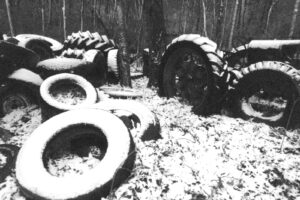
Figures from USTMA’s 2023 End-of-Life Tire Management Report (released October 24, 2024), the latest full edition as of October 2026.
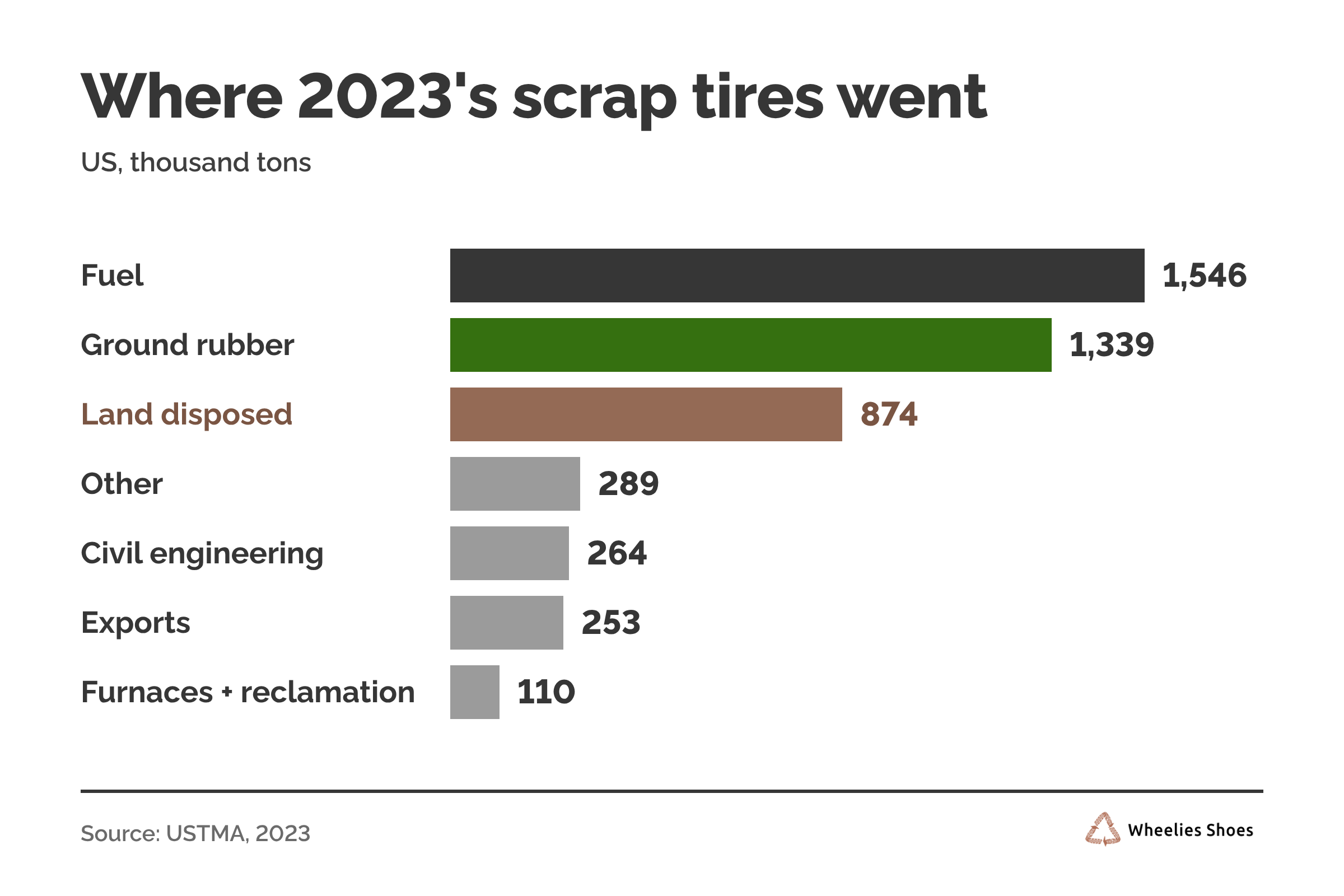
In 2023 the US generated 264 million scrap tires, about 4.8 million tons. According to the U.S. Tire Manufacturers Association, 79% of them went to some kind of market. The biggest single destination was fuel: 32% of the tonnage was burned in cement kilns, paper mills and power plants. About 48 million tires went into the ground.
Landfill is the number going the wrong way. Tires sent to land disposal rose 19% between 2021 and 2023, even though slightly fewer tires were generated. Meanwhile the old tire mountains are mostly gone: stockpiles fell from about a billion tires in 1990 to just under 48 million. (Yes, both of those are 48 million. It’s a coincidence, and they’re different tires.)
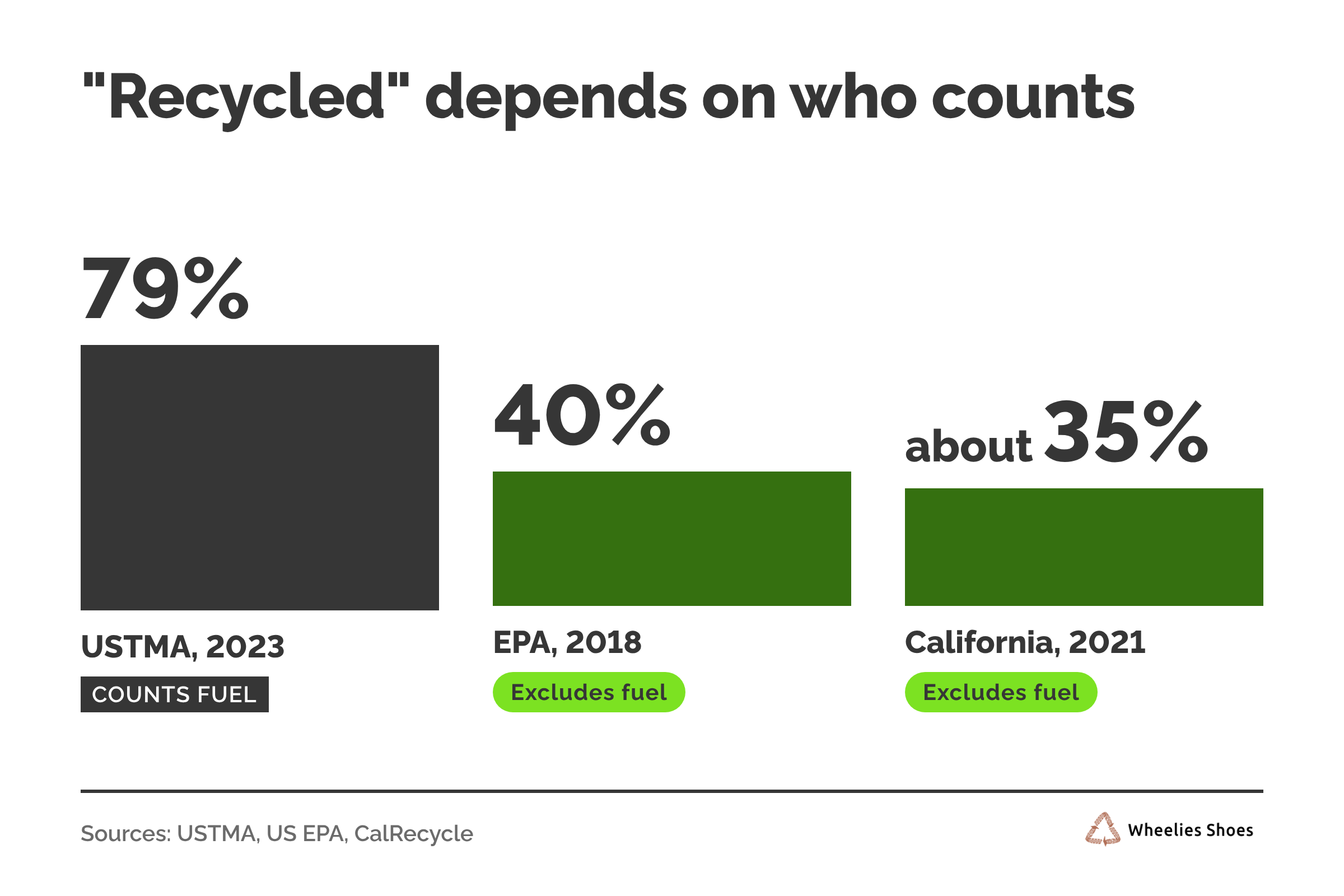
The 79% figure is the one everyone quotes. Take out the tires that were burned and it drops to 47%. If you’re holding an old tire right now, skip to what to do with your own old tires.

The 2023 numbers in one table
The U.S. Tire Manufacturers Association (USTMA) is the trade association for the companies that make tires in the US, and it has tracked scrap tires since 1990. Its report comes out every two years. The table below is its 2023 disposition table, with one column we added: each destination as a share of all tires generated.
| Where US scrap tires went (2023) | Thousand tons | Million tires | Change since 2021 | Share of all generated |
|---|---|---|---|---|
| Tire-derived fuel | 1,546 | 84 | +10.9% | 32.0% |
| Cement kilns | 784 | 43 | +15.0% | 16.2% |
| Pulp and paper mills | 562 | 31 | +7.2% | 11.6% |
| Electric utilities | 200 | 11 | +6.5% | 4.1% |
| Ground rubber | 1,339 | 73 | -4.8% | 27.7% |
| Civil engineering | 264 | 14 | -4.5% | 5.5% |
| Exported | 253 | 14 | +189.4% | 5.2% |
| Electric arc furnaces | 70 | 4 | +14.2% | 1.4% |
| Reclamation projects | 40 | 2 | -15.8% | 0.8% |
| Other | 289 | 16 | -5.4% | 6.0% |
| Total to a market | 3,801 | 207 | +6.2% | 78.6% |
| Land disposed | 874 | 48 | +19.3% | 18.1% |
| Generated (net scrap tires) | 4,836 | 264 | -3.9% | 100% |
Two things to know before you quote these numbers
Check the denominator. USTMA’s own pie chart says fuel took 33% and land disposal 19%. Those are shares of the tires USTMA could account for, which was 97% of the total. Against every tire generated, the figures are 32% and 18%. If you cite the report, say which one you mean.
Know what “generated” means. USTMA doesn’t weigh every tire. It collects data from every state that has a tire program, converts it to weight, and adds surveys of major recyclers, trade press and expert interviews. Generation is calculated from replacement tires sold and vehicles scrapped. In 2023, haulers picked up 304 million tires. About 40 million of those still had usable life and were pulled out for resale as used tires, which leaves the 264 million net scrap figure. The 3% nobody could trace is, in USTMA’s words, “most likely landfilled.”
What “recycled” means in each market
“To market” covers very different fates. Some tires become a playground surface you could still recognize as rubber. Others are burned in a cement kiln.
Tire-derived fuel: 1,546 thousand tons
Shredded or whole tires go into the fuel mix at cement kilns (51% of fuel use), pulp and paper mills (36%) and electric utilities (13%). Tires burn hot. According to the EPA’s archived scrap tire guidance, they produce the same energy as oil and 25% more than coal. The same page draws a clear line, though: using tires as fuel “is not recycling, but is considered a beneficial use.” Fuel use grew 11% from 2021 to 2023, and USTMA attributes most of that to higher natural gas and fossil fuel prices tied to the war in Ukraine.
Ground rubber: 1,339 thousand tons
Crumb is the version most people picture. Tires are shredded and ground into crumb. The EPA sorts it by size: “ground” rubber is 10 mesh and smaller, and “coarse” rubber is anything larger, up to half an inch. Here’s where the crumb went in 2023:
| Ground rubber end use (2023) | Thousand tons | Share of ground rubber |
|---|---|---|
| Playground and loose mulch | 385 | 29% |
| Molded and extruded products | 362 | 27% |
| Sports surfaces | 349 | 26% |
| Asphalt | 165 | 12% |
| Automotive | 79 | 6% |
The growth is in asphalt: rubber-modified asphalt took 17% more tire rubber than in 2021. Sports surfaces grew 12%. Industrial and automotive uses fell 22%, though USTMA notes the 2021 figures may have been overreported.
Civil engineering: 264 thousand tons
Large tire shreds, called tire-derived aggregate, go into construction as a lightweight material. The engineering standard, ASTM D6270, covers its use as lightweight embankment fill, retaining wall backfill, drainage layers, insulation and vibration damping under rail lines. It applies only to fills less than 3 meters (about 10 feet) thick.
Exports, furnaces and the rest
Exports nearly tripled, to 253 thousand tons. USTMA itself flags that a growing share is arriving in India, which it says “does not have the necessary regulations in place to ensure safe storage or proper use.” Electric arc furnaces took 70 thousand tons, reclamation projects 40, and a catch-all “other” 289.
Land disposal: 874 thousand tons
That’s 48 million tires. Rules vary a lot by state: according to USTMA’s count of state rules, 11 states allow whole tires in landfills, 37 allow cut or shredded tires, and 24 allow monofills, landfills that take only tires.
Why the recycling rate is 79% or 40%
USTMA’s 79% counts fuel. The EPA doesn’t. In its tire data for 2018, the EPA puts the tire recycling rate at 40.0%, with 41.5% “combusted with energy recovery” and 18.5% landfilled. California’s waste agency, CalRecycle, reports its own tire recycling rate as “around 35 percent” in 2021, a figure that also excludes fuel.
You can run the same subtraction on USTMA’s own 2023 table. Take fuel out and 2,255 thousand tons went to a non-fuel market: 47% of generation, and that still counts exports. Put another way, 41% of everything USTMA counts as “to market” was burned.
That matters when you see comparisons. USTMA’s report sets tires at 79% beside aluminum cans (45%) and PET bottles (29%). Without fuel, tires drop to about 47%: behind lead-acid batteries (99%) and paper (68%), and just ahead of cans. Those figures come from different bodies and years, so the ranking is rough.
Where tire-sole shoes fit
Wheelies soles are cut from old tires, tread pattern and all, so we went looking for ourselves in these numbers. We’re not in ground rubber. The EPA’s archived FAQ lists shoe soles among products that are “cut, punched, and stamped” from scrap tires after the steel bead is removed. USTMA tracks that category as Punched/Stamped: 41 thousand tons in 2015, 23 in 2017, 10 in 2019, and zero in both 2021 and 2023.
So in national terms, cut-tire products are a rounding error. The volume story is fuel and crumb, and anyone who tells you their shoes are solving the scrap tire problem is overselling. What the category does have going for it is where it sits in the EPA’s order of preference: reduce, reuse, recycle, waste-to-energy, then disposal. A sole cut from tread keeps the rubber as rubber, without grinding it or burning it.
Why stockpiles shrank, and why landfill didn’t
The cleanup is a real success. USTMA estimates there were about a billion scrap tires sitting in piles in 1990. By 2023, 95% had been cleaned up and just under 48 million remained. Piles are worth clearing: tires collect standing water where mosquitoes breed, and a tire fire releases benzene, butadiene and polycyclic aromatic hydrocarbons.
What’s left is concentrated. Colorado has over 20 million tires in piles, Texas 10 to 20 million, and New Mexico and New Jersey 1 to 5 million each. USTMA says all four have active cleanup programs. (One caveat on Colorado: the 2021 edition noted its count includes half of its tire monofill inventory.)
Most of that work runs through state programs. Out of 50 states, 36 collect a fee on tires, 44 regulate tire storage and disposal, 37 require haulers to hold permits, and 30 have a stockpile cleanup program, 22 of them active.
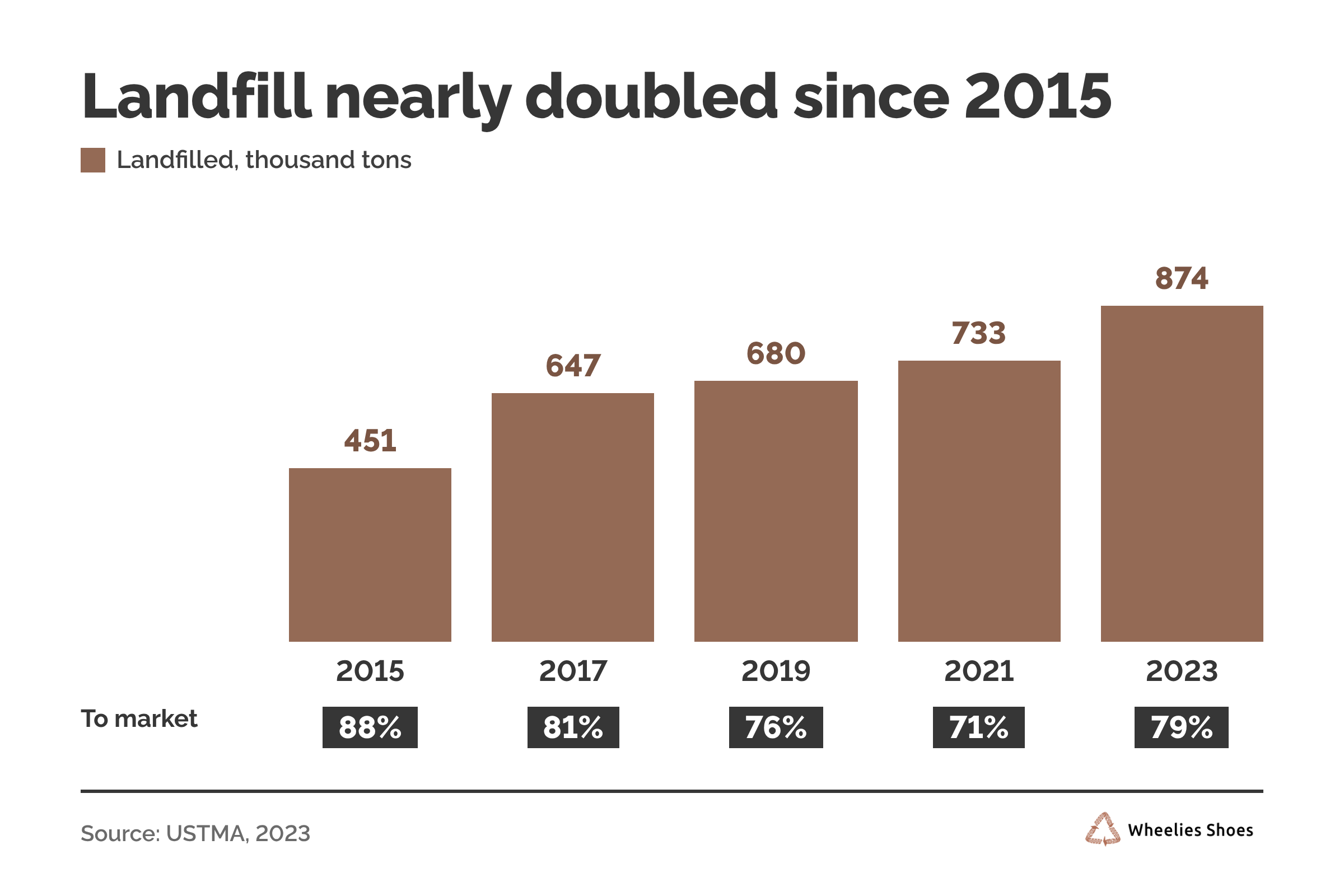
Landfill went the other way. Tons sent to land disposal went up in every edition since 2015, from 451 thousand to 874 thousand in 2023. That’s a 94% rise while generation rose 20%. The market share fell from 88% to 71% before bouncing back to 79%. USTMA credits the bounce mostly to fuel, but exports, which nearly tripled, added even more tons. USTMA says outright that it’s “concerned about a 19% increase in tires going to landfills.”
| Year | Generated (thousand tons) | To a market (thousand tons) | Share to market | Land disposed (thousand tons) |
|---|---|---|---|---|
| 2015 | 4,039 | 3,551 | 88% | 451 |
| 2017 | 4,189 | 3,411 | 81% | 647 |
| 2019 | 4,464 | 3,379 | 76% | 680 |
| 2021 | 5,031 | 3,579 | 71% | 733 |
| 2023 | 4,836 | 3,801 | 79% | 874 |
Two states, two approaches
California and Texas show how differently states run this. The years and accounting methods differ, so read this as a contrast rather than a scorecard.
| California | Texas | |
|---|---|---|
| Fee on new tires | $1.75 per tire ($1.00 to CalRecycle, $0.75 to the Air Resources Board), extended to January 1, 2034 | None. No dedicated program funding; dealers set their own disposal fees |
| Share disposed | 45% disposed (2021) | 18% landfilled, of about 57.2 million tires managed (2023) |
| Other markers | Diversion fell to 55% in 2021, from a high of 92.9% in 2012 | Crumb rubber 33%, fuel 31% |
A fee doesn’t guarantee much on its own: California collects one and still disposed of 45% of its waste tires in 2021.
What comes next (preliminary)
The 2025 edition isn’t out yet. A USTMA conference deck from May 2026, marked DRAFT, says many 2025 state reports are still missing. Its early read: about 273 million scrap tires in 2025, stockpiles down to 41 million, landfill disposal down from 2023, and exports up again, to India, Japan and Korea. It also says pyrolysis now takes more than 1% of US scrap tires and will get its own line in the next report.
What you can do with old tires
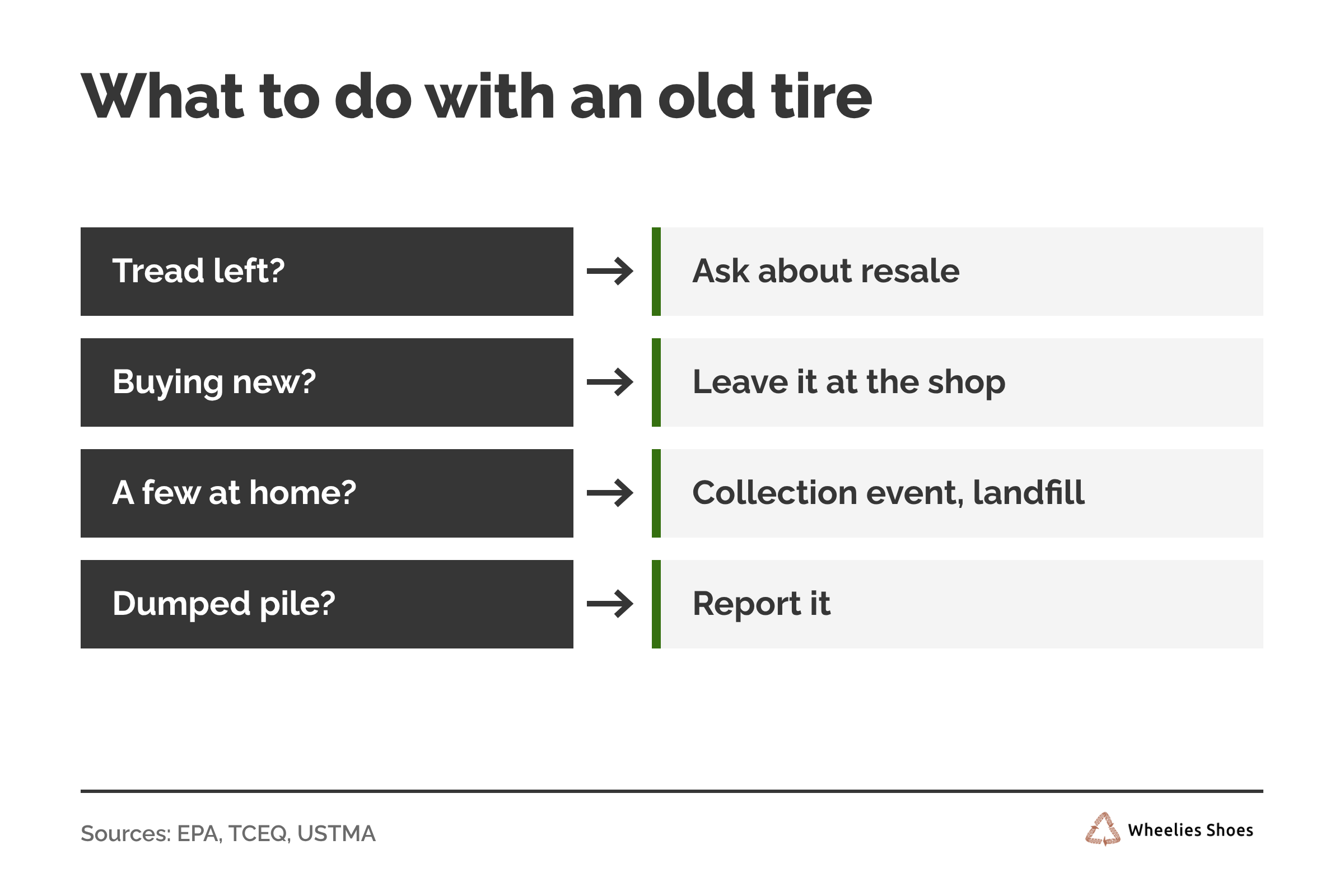
Most of what happens to a scrap tire is out of your hands. The one decision you make is where it goes when it comes off your car.
- Make them last. The EPA’s advice still holds: keep tires inflated, rotate them every 4,000 miles, and buy durable tires. For commercial vehicles, retreading is an option that USTMA says cuts energy use, CO2 emissions and raw material use.
- When you buy new, leave the old ones at the shop. A disposal fee is usually charged. If a tire still has tread left, ask whether it can be sold on as a used tire: haulers pulled about 40 million usable tires out for resale in 2023, by USTMA’s count.
- A few tires at home? Look for a local tire collection or bulky trash event, or call your county transfer station. A landfill may take them, usually for a fee. In Texas, tires must be split, quartered or shredded first, according to TCEQ.
- Found a dumped pile? Report it to your city, county or state environmental office. Some states fund cleanup from tire fees: Colorado’s new program pays for cleaning up illegally dumped tires.
- Buying recycled-rubber products? The EPA doesn’t certify recycled tire content, so ask the maker what’s actually in the product.
Many states also add a fee to every new tire. A few, from state pages and USTMA’s state legislation summary (updated October 2024):
| State | Fee on a new tire |
|---|---|
| California | $1.75, through January 1, 2034 |
| Colorado | $1.50, starting January 1, 2026 (CDPHE) |
| New York | $2.50, through December 31, 2027 (the seller keeps $0.25) (NY Tax Department) |
| Rhode Island | $5 deposit, refunded if you bring a used tire back within 14 days |
| Texas | None |
FAQ
How many tires are thrown away in the US each year?
USTMA counted 264 million net scrap tires in 2023, about 4.8 million tons. That’s after 40 million still-usable tires were pulled out of the 304 million that haulers collected. USTMA’s own web pages round the yearly figure to “more than 230 million” or “more than 250 million,” so cite the report table. A draft of the 2025 edition puts it at about 273 million.
What percentage of tires are recycled?
It depends on whether burning tires for fuel counts. USTMA says 79% went to a market in 2023, fuel included. The EPA’s figure for 2018 is 40% recycled, with fuel counted separately. Take fuel out of USTMA’s 2023 numbers and about 47% went to a non-fuel market.
Is burning tires for fuel recycling?
Not by the EPA’s definition. Its archived guidance calls tire-derived fuel “not recycling, but… a beneficial use,” better than landfill but below recycling in its order of preference. USTMA counts it in its market rate. Fuel was the largest single market in 2023, and USTMA names more fuel use, driven by higher fossil fuel prices, as the main reason the overall rate rose.
Why do I pay a tire fee?
About three dozen states charge a fee on new tires to fund their scrap tire programs. In California, $1.00 of the $1.75 goes to CalRecycle and $0.75 to the Air Resources Board. Colorado’s new $1.50 fee pays for recycling grants, rebates to end users and cleanup of illegally dumped tires. USTMA supports “reasonable fees” for state programs.
Can old tires be made into new tires?
Only a little. According to the EPA, rubber ground from scrap tires can go back into a new tire as a low-volume filler. It stays a small percentage of the new tire, mainly because of product quality constraints.
Sources
All sources accessed October 8, 2026.
- U.S. Tire Manufacturers Association, 2023 End-of-Life Tire Management Report (PDF) and report page, released October 24, 2024.
- USTMA, 2021 US Scrap Tire Management Summary (PDF), October 25, 2022.
- USTMA, State End-of-Life Tire Legislation Summary (PDF), updated October 2024.
- USTMA, 2025 End-of-Life Tire Market Trends (DRAFT, Tire Recycling Foundation conference, May 2026).
- USTMA, Tire Recycling and ELTs Explained.
- US EPA, Durable Goods: Product-Specific Data and Rubber and Leather: Material-Specific Data.
- US EPA (archived), Scrap Tires: Frequently Asked Questions, Tire-Derived Fuel, Ground Rubber Applications.
- ASTM International, D6270-20, Standard Practice for Use of Scrap Tires in Civil Engineering Applications.
- CalRecycle, Twelfth Edition Five-Year Plan for the Waste Tire Recycling Management Program.
- Texas Commission on Environmental Quality, 2023 Scrap Tire Annual Report Summary (PDF) and Tire Disposal Q&A.
- New York State Department of Taxation and Finance, Waste tire management and recycling fee and 2025 changes.
- Colorado Department of Public Health and Environment, Waste Tire Management Enterprise.
Featured photo: abandoned tire stockpile in Palmersville, Tennessee, by Katangais, via Wikimedia Commons, licensed CC BY 2.5; cropped and color-corrected.