Rules and figures checked on each body’s own site on 8 October 2026.
Nobody hands out a “sustainable” label for shoes in the US. The Federal Trade Commission sets the benchmark through its Green Guides, which are guidance, and it goes after deceptive claims under Section 5 of the FTC Act. Trade groups such as FDRA, Cascale, Textile Exchange, ReMA and USTMA write standards and publish data. They don’t decide what’s legal.
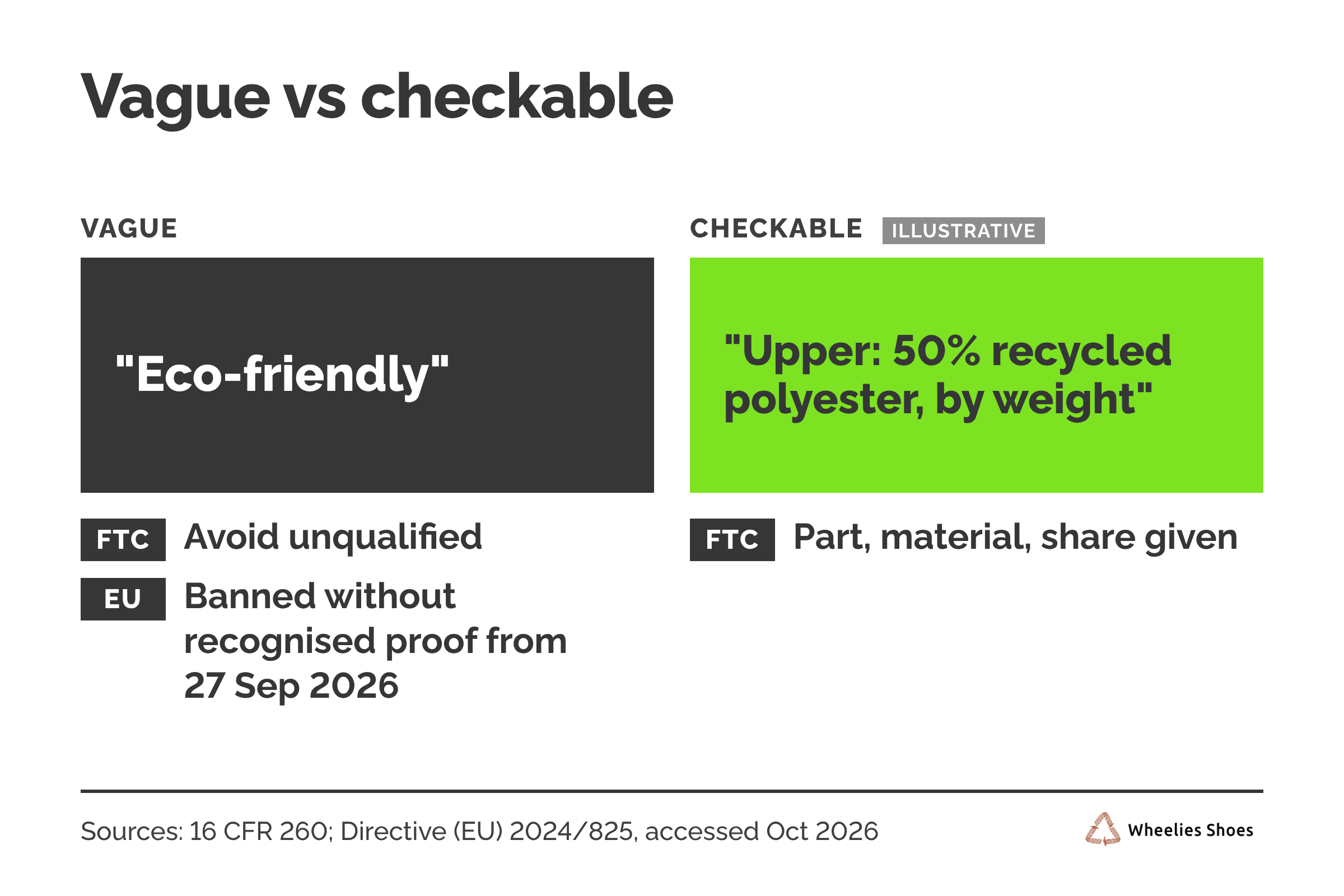
Two rules matter more on a shoe box than the rest. Skip the bare “eco-friendly”. And only call something “recyclable” if recycling is available to at least 60% of the people who buy it. In the EU, a generic claim like “eco-friendly” that the seller can’t back with recognised excellent environmental performance joined the list of banned practices on 27 September 2026.

What the FTC’s Green Guides say
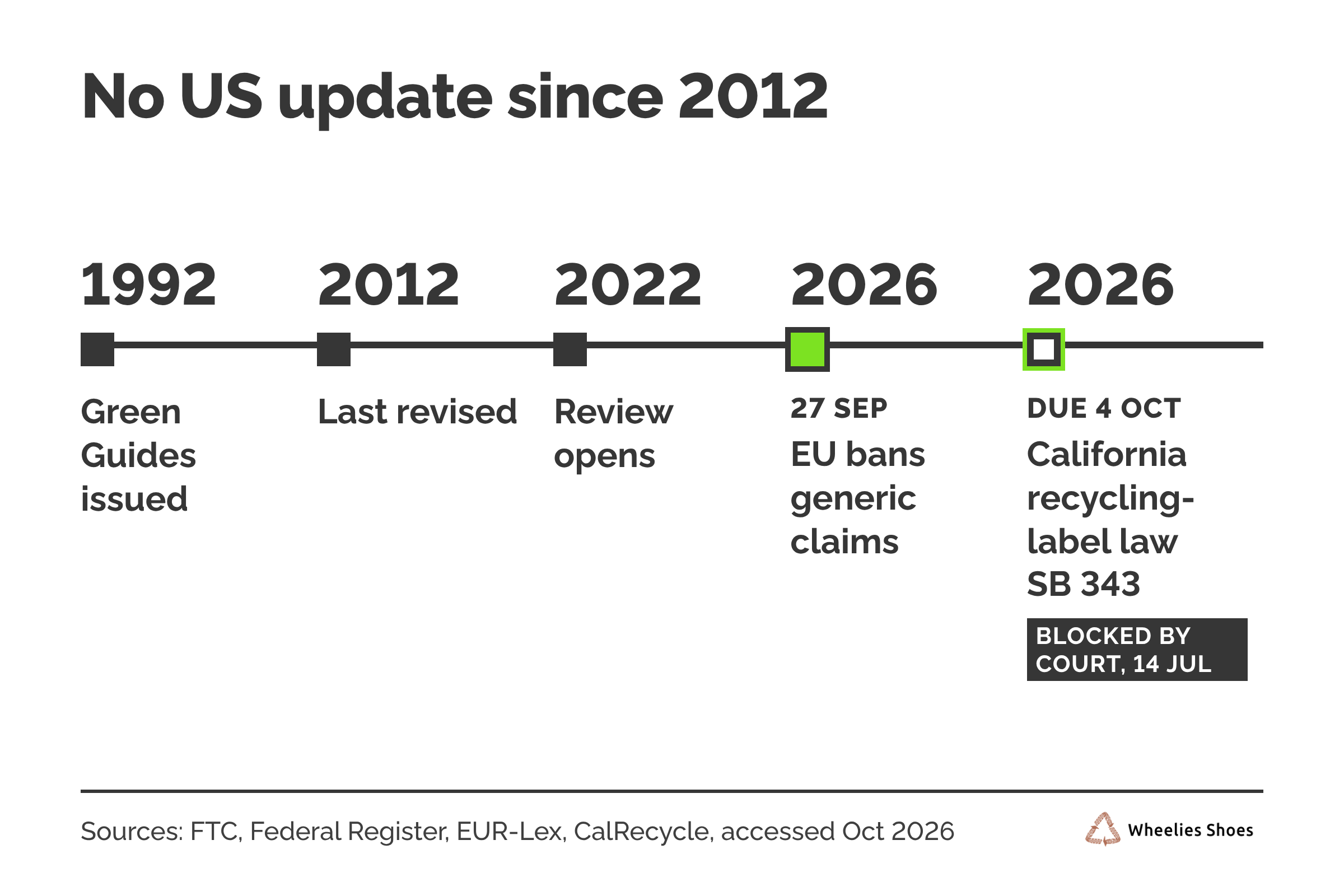
The Green Guides live in the federal code at 16 CFR Part 260. The FTC first issued them in 1992 and revised them in 1996, 1998 and 2012. They are not law. Section 260.1 calls them the FTC’s “current views” and “do not operate to bind the FTC or the public.” The teeth come from the statute: the Commission “can take action under the FTC Act if a marketer makes an environmental claim inconsistent with the guides.”
They cover claims made “through words, symbols, logos, depictions, product brand names,” so a leaf icon counts. They don’t preempt state laws, so states can add rules on top. And a green claim needs a reasonable basis, which “often requires competent and reliable scientific evidence.” Applied to a shoe:
| On the box or the product page | What the Green Guides say | Section |
|---|---|---|
| “Eco-friendly”, “green”, nothing else | Don’t. An unqualified general claim is “highly unlikely” to be substantiated in every reasonable reading. | 260.4(b) |
| “Eco-friendly: made with recycled materials” | Can pass, but only if four conditions hold (below). | 260.4, Ex. 1 |
| “Recyclable” | Only if recycling is available to at least 60% of consumers or communities where it’s sold. | 260.12(b) |
| “Recyclable where facilities exist” | Deceptive when most buyers lack access. | 260.12, Ex. 4 |
| “Made with recycled ___” | Must be diverted from the waste stream. Partly recycled? Give the amount or percentage by weight. | 260.13 |
| Chasing arrows with no words | Likely read as recyclable and made entirely of recycled material. | 260.13, Ex. 8 |
| A seal that doesn’t say what it certifies | Don’t use it. | 260.6(d) |
| “50% more recycled content than before” | Misleading if it went from 2% to 3%. | 260.3, Ex. 1 |
“Eco-friendly” is the riskiest word on a shoe box
The FTC’s own first example in Section 260.4 is a product whose brand name is “Eco-friendly.” That, it says, “likely conveys that the product has far-reaching environmental benefits,” and it’s deceptive. The fixed version, “Eco-friendly: made with recycled materials,” is fine only if:
- “made with recycled materials” is clear and prominent;
- the entire product or package, apart from minor, incidental components, is recycled material;
- using recycled material makes the product better for the environment overall; and
- nothing else in the ad implies more.
Condition 2 is the one to watch on a sneaker. A shoe with a recycled upper and a virgin foam sole isn’t “made with recycled materials” in the FTC’s sense. And you don’t need words to make the claim. Example 3 in the same section is a laser printer sitting in a bird’s nest in a dense forest under the line “Make a change.” The FTC calls that ad deceptive. Swap the printer for a sneaker on moss and you get the idea.
“Recyclable” has a number attached: 60%
Under Section 260.12, something is recyclable only if it can be recovered “through an established recycling program.” Going unqualified takes facilities available to “a substantial majority” of buyers, defined as “at least 60 percent.” Below that, add a qualifier such as “This product may not be recyclable in your area.” Keep Section 260.12’s Example 3 in mind for the tire section: a container that can only be “burned in incinerator facilities to produce heat and power” can’t be called recyclable.
“Made with recycled ___”, seals, and product versus box
Recycled content has to come out of the waste stream, before or after consumer use. Factory scraps that go straight back into the same process don’t count. On seals, Section 260.6 adds two points: a third-party certificate doesn’t excuse the seller from backing up what the seal says, and a certifier that’s really an industry trade association shouldn’t be passed off as independent. And Section 260.3 wants every claim to say whether it means the product, the packaging or one part. On a shoe, that’s the difference between “recycled” on the shoebox and “recycled” on the sole.
Is there a 2026 update to the Green Guides? Not yet. The FTC published its ten-year review request in the Federal Register on 20 December 2022, extended comments to 24 April 2023, and held a public workshop on “recyclable” claims. As of 8 October 2026, the Federal Register has nothing newer under Part 260 than that March 2023 workshop notice, and the 2012 text is still the current one.
Does the FTC enforce this on clothing?
Yes. In April 2022 Kohl’s and Walmart agreed to pay $2.5 million and $3 million over rayon sold as “bamboo” with eco-friendly process claims, when making that rayon “requires the use of toxic chemicals.”
California and the EU add their own layer
California. SB 343 bars the chasing arrows “or any other indicator of recyclability” unless set criteria are met, for products and packaging made after 4 October 2026. Don’t assume it’s being enforced, though. On 14 July 2026 a federal court preliminarily enjoined enforcement of SB 343 (California League of Food Producers v. Bonta), according to CalRecycle.
The EU. Directive (EU) 2024/825, adopted 28 February 2024, required member states to apply its rules from 27 September 2026. It adds three bans that hit shoes directly: a generic claim the trader can’t back with “recognised excellent environmental performance” (point 4a); a claim about the whole product when it’s true of only one part (4b); and a sustainability label not based on a certification scheme or set by a public authority (2a). Recital 9 lists “eco-friendly”, “green” and “biodegradable” as generic. A claim stops being generic once the specifics sit beside it. A broader proposal, the Green Claims Directive, is stalled: the Commission said on 20 June 2025 that it intends to withdraw it.
The trade groups, and what each one publishes
Only the first row has legal force.
| Body | What it is | What it publishes that touches a shoe claim | Legal force |
|---|---|---|---|
| FTC | Federal regulator | The Green Guides, 16 CFR Part 260 | Guides are advisory; Section 5 enforcement is binding |
| FDRA (Footwear Distributors and Retailers of America) | Footwear trade association, founded 1944, nearly 500 companies and brands | Public case for footwear-specific standards; a 2025 carbon report it promotes, written by FDRA SVP Andy Polk for the Footwear Innovation Foundation; sustainability briefs for members only | None; voluntary membership group |
| Cascale (formerly the Sustainable Apparel Coalition) | 501(c)(6) nonprofit funded by member dues; over 300 members in 36 countries as of December 2023 | The Higg Index, including the Materials Sustainability Index (MSI) and Product Module | None; voluntary tools, available only through Worldly |
| Textile Exchange | Standards owner and market-data publisher for fibers and materials | Recycled Claim Standard (RCS), Global Recycled Standard (GRS), annual Materials Market Report | None; brands opt in to certification |
| ReMA (formerly ISRI) | Recycling industry association, formed 1987, over 1,700 member companies | The ISRI Specifications for trading recycled commodities, including tire-derived grades; policy comments on recycling labels | None; trading guidelines for industry |
| USTMA (U.S. Tire Manufacturers Association) | Trade association of tire makers producing in the US; 55 facilities in 16 states | The End-of-Life Tire Management Report, every two years | None; publishes industry data |
FDRA argues that fashion standards don’t fit footwear “because shoes aren’t shirts”: a shoe can have “upwards of 70 materials and components,” against five for a t-shirt. Cascale began in 2009, when Walmart and Patagonia brought peers together to measure sustainability one common way, and renamed itself in February 2024 (“Cas” is “SAC” reversed).
Textile Exchange runs the two recycled standards you’re most likely to see on a sneaker tag. The RCS covers products with at least 5% recycled material. The GRS needs 20% to certify and 50% before a brand can make a consumer-facing claim, both by weight of certified components. Textile Exchange’s FAQ says the GRS is being replaced by a new Materials Matter Standard during 2026 (voluntary from Q1, mandatory expected mid-2026), and that superseded standards will be retired on a transition timeline.
Its 2025 Materials Market Report has a number worth knowing before you pay extra for “recycled polyester”: about 98% of recycled polyester is still made from plastic bottles. Recycled fibers of every kind were about 7.6% of the world’s fiber in 2024, and less than 1% came from recycled textiles.
In June 2022 the Norwegian Consumer Authority ruled a clothing company’s marketing based on Higg MSI data misleading. The coalition then paused members’ use of that data in marketing, and in October 2022 Norway and the Dutch ACM said ads using such figures should make clear they are global averages.
Tires in your shoes: what “recycled” means for rubber
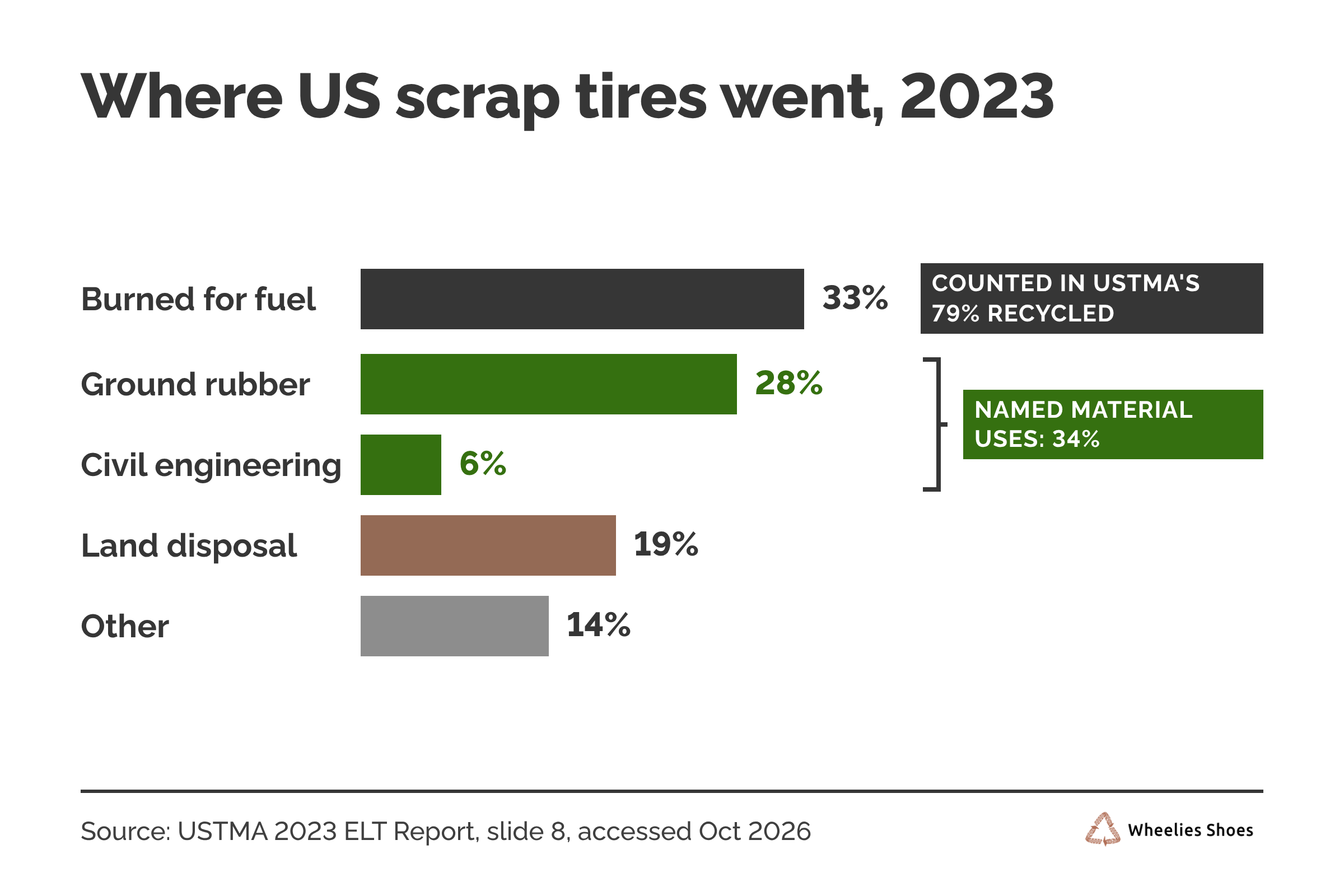
USTMA’s 16th End-of-Life Tire Management Report, released 24 October 2024, says 79% of end-of-life tires were “reclaimed or recycled” in 2023, up from 71% in 2021 and 76% in 2019. Open the report’s pie chart and the biggest slice is tire-derived fuel at 33%. That’s tires burned for energy, and under the FTC’s incinerator example, something that can only be burned for heat and power can’t be called recyclable.
Take fuel out, and the two named slices where the rubber clearly becomes another material are ground rubber (28%) and civil engineering (6%), 34% together. Land disposal was 19%. Part of the 14% “other” (misc. uses 7%, exported 5%, electric arc furnace 1%, reclamation projects 1%) may count too. Our full breakdown of where old tires go has the tonnage table.
So what should a shoe say? Name the part (“outsole”), the material (“recycled tire rubber”) and the share by weight, and use “recycled” only for rubber diverted from the waste stream. The trade has its own vocabulary too: ReMA’s ISRI Specifications list 15 tire-derived material grades, filed under rubber primarily used for civil engineering, so scrap tire material is traded by named grade.
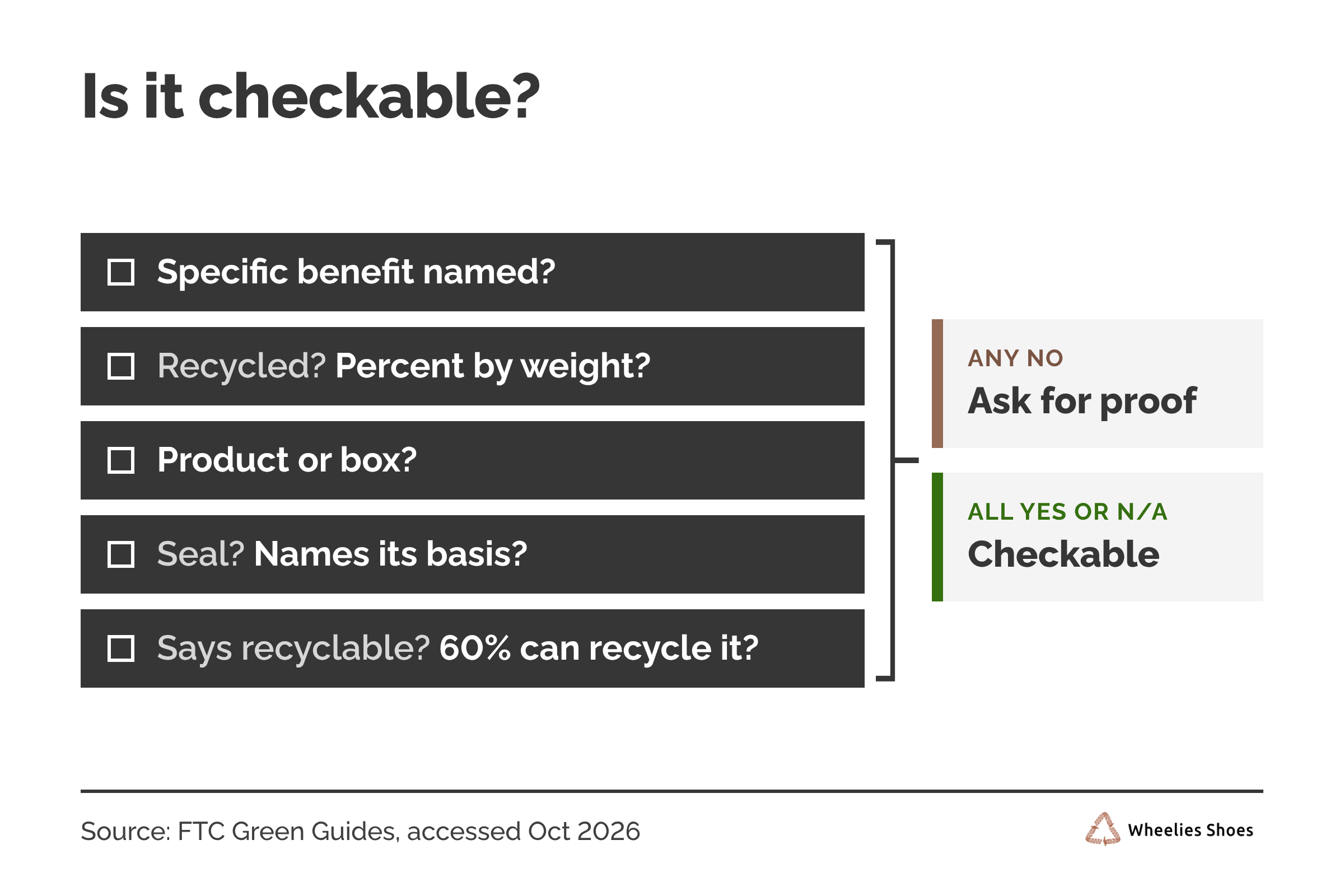
How to check a shoe’s green claim in five minutes
Open the product page and run down this list.
- Is it a bare general word? “Eco-friendly”, “green” or “sustainable” with nothing specific beside it runs against FTC guidance, and in the EU it’s on the banned list unless the seller can prove recognised excellent performance.
- Does it say what’s recycled, and how much by weight? “Upper: 50% recycled polyester” is checkable. “Made with recycled materials” on a mostly virgin shoe is not.
- Which part? Shoe, sole, upper, laces or box. Both the FTC and the EU say a claim about one part shouldn’t read as a claim about the whole thing.
- Is there a seal? It should say what it certifies and who awarded it. Look the certificate up yourself. A GRS logo on a consumer product means at least 50% recycled input in the certified components.
- “Recyclable”? Ask where. Unless recycling for that product is open to at least 60% of buyers, the claim needs a qualifier. A brand take-back program is a different thing and should be described as one.
If the page quotes a carbon number, find the year, the method and who paid for the study. These two figures aren’t comparable:
| Figure | Study | Data from | Who’s behind it |
|---|---|---|---|
| 30 lb CO2 per pair of running shoes; 65 parts, 360+ processing steps | MIT-led study, published 2013 | Factory data, August 2010 to January 2011 | MIT-led research on an ASICS running shoe |
| 6.7 kg CO2-eq per pair cradle to grave; 1.5 kg to manufacture; footwear about 0.45% of global emissions | 2025 Footwear Carbon Report | A researched “typical shoe” | Footwear Innovation Foundation; author Andy Polk is also a Senior Vice President at FDRA |
Why these answers are so hard to find
The primary sources are long and some sit behind member logins:
- The Green Guides run to 17 sections, 69 worked examples and about 9,600 words, by our count of the eCFR text.
- Textile Exchange’s 2025 Materials Market Report is 76 pages and about 41,000 words.
- FDRA’s Shoe Sustainability Briefs sit in its member-only Intel Center.
Member organizations publish for members and revise as the data improves. So when you quote one of the figures above, quote the page and the year with it, and for a rule, quote the clause it comes from rather than a search snippet. Every rule in this post links to its section.
FAQ
Who regulates “eco-friendly” claims on shoes in the US?
The Federal Trade Commission. Its Green Guides (16 CFR Part 260) are guidance, enforced through Section 5 of the FTC Act, and they say marketers should not make unqualified general claims like “eco-friendly.”
What does “GRS certified” mean on a sneaker?
Textile Exchange’s Global Recycled Standard: a consumer-facing GRS claim needs at least 50% recycled input by weight of certified components. Textile Exchange is replacing the GRS with its Materials Matter Standard during 2026.
Can a shoe be labeled “recyclable”?
Without a qualifier, only if recycling for it is available to at least 60% of the people or communities where it’s sold. Below that, the label needs a clear qualifier, and “Recyclable where facilities exist” isn’t one.
Is tire rubber that was burned for fuel “recycled”?
Not by the Green Guides’ logic: something that can only be burned for heat and power can’t be called recyclable. USTMA’s 79% “reclaimed or recycled” for 2023 includes the 33% used as fuel.
Sources
All accessed 8 October 2026.
- Federal Trade Commission, Guides for the Use of Environmental Marketing Claims, 16 CFR Part 260 (eCFR), and Green Guides topic page.
- Federal Register, request for public comment, 20 December 2022, and workshop notice, 7 March 2023.
- FTC, press release on Kohl’s and Walmart, 8 April 2022.
- CalRecycle, Recycling labels and SB 343.
- EUR-Lex, Directive (EU) 2024/825; European Parliament Legislative Train, Substantiating green claims.
- Forbrukertilsynet (Norwegian Consumer Authority), guidance on environmental claims to the textile industry, 11 October 2022.
- Cascale, About, FAQs and Introducing Cascale.
- Textile Exchange, Standards FAQs and Materials Market Report 2025 (PDF).
- FDRA, About FDRA, Intel Center (member-only) and Right-Sized Standards; Footwear Innovation Foundation, 2025 Footwear Carbon Report (PDF).
- MIT News, footwear carbon footprint study, 22 May 2013.
- ReMA, About ReMA, rebrand press release, April 2024 and ISRI Specifications, tire-derived material.
- USTMA, About Us, 2023 End-of-Life Tire Report page and full report (PDF).
Featured image: the international recycling symbol by Krdan, via Wikimedia Commons, public domain.